Need Expert Advice?Our Gurus Can Help
Should I Quit My Job? Expert Advice for a 32-Year-Old Woman Feeling Stuck in Her Career
Milind Vadjikar | Answer |Ask -Follow
Insurance, Stocks, MF, PF Expert - Answered on Jan 21, 2025
Milind Vadjikar is an independent MF distributor registered with Association of Mutual Funds in India (AMFI) and a retirement financial planning advisor registered with Pension Fund Regulatory and Development Authority (PFRDA).
He has a mechanical engineering degree from Government Engineering College, Sambhajinagar, and an MBA in international business from the Symbiosis Institute of Business Management, Pune.
With over 16 years of experience in stock investments, and over six year experience in investment guidance and support, he believes that balanced asset allocation and goal-focused disciplined investing is the key to achieving investor goals.... more
He has a mechanical engineering degree from Government Engineering College, Sambhajinagar, and an MBA in international business from the Symbiosis Institute of Business Management, Pune.
With over 16 years of experience in stock investments, and over six year experience in investment guidance and support, he believes that balanced asset allocation and goal-focused disciplined investing is the key to achieving investor goals.... more
 Question by Sun on Jan 20, 2025Hindi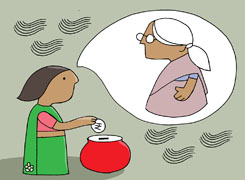
Thank you for the reply.
Ans: Your are welcome!!
DISCLAIMER: The content of this post by the expert is the personal view of the rediffGURU. Users are advised to pursue the information provided by the rediffGURU only as a source of information to be as a point of reference and to rely on their own judgement when making a decision.
MoneyReply


You may like to see similar questions and answers below
Sanjeev Govila | Answer |Ask -Follow
Financial Planner - Answered on Dec 27, 2023

Baqar Iftikhar Naqvi | Answer |Ask -Follow
Start-up Mentor - Answered on Feb 23, 2024

Ashwini Dasgupta | Answer |Ask -Follow
Personality Development Expert, Career Coach - Answered on Sep 27, 2024


Milind Vadjikar | Answer |Ask -Follow
Insurance, Stocks, MF, PF Expert - Answered on Dec 01, 2024

Latest Questions
Archana Deshpande |121 Answers |Ask -Follow
Image Coach, Soft Skills Trainer - Answered on May 22, 2026

Dr Nagarajan J S K |3045 Answers |Ask -Follow
NEET, Medical, Pharmacy Careers - Answered on May 21, 2026

Dr Nagarajan J S K |3045 Answers |Ask -Follow
NEET, Medical, Pharmacy Careers - Answered on May 21, 2026


Dr Nagarajan J S K |3045 Answers |Ask -Follow
NEET, Medical, Pharmacy Careers - Answered on May 21, 2026


Sir my son got 110 marks in comedk 2026,what rank can we expect and where should we try for admission
Ans: HI
GREETINGS FROM REDIFFGURUS!
Based on your COMEDK score, your rank will be between 3,500 and 4,500. This competitive rank qualifies you for top-tier engineering branches such as Electronics and Communication Engineering (ECE) and Electrical and Electronics Engineering (EEE) in Tier-1 colleges, as well as core Computer Science Engineering (CSE) branches in highly reputable Tier-2 institutions across Karnataka.
1. Tier-1 Colleges (Top Institutions)
- RV College of Engineering (RVCE): EEE, Chemical Engineering, Aerospace Engineering
- BMS College of Engineering (BMSC): ECE, EEE
- MS Ramaiah Institute of Technology (MSRIT): ECE, EEE, Mechanical Engineering
2. Tier-2 & Premium Institutions (Top Branches)
- Dayananda Sagar College of Engineering (DSCE) & BMS Institute of Technology (BMSIT): CSE, Artificial Intelligence (AI) & Machine Learning (ML), Information Science Engineering (ISE)
- Nitte Meenakshi Institute of Technology (NMIT) & B. M. Sreenivasaiah Institute of Technology (BIT): CSE and related specializations
- Siddaganga Institute of Technology (SIT): CSE
Now the choice is yours. Participate in the counseling process and seize the best opportunity for your future.
BEST WISHES.
GREETINGS FROM REDIFFGURUS!
Based on your COMEDK score, your rank will be between 3,500 and 4,500. This competitive rank qualifies you for top-tier engineering branches such as Electronics and Communication Engineering (ECE) and Electrical and Electronics Engineering (EEE) in Tier-1 colleges, as well as core Computer Science Engineering (CSE) branches in highly reputable Tier-2 institutions across Karnataka.
1. Tier-1 Colleges (Top Institutions)
- RV College of Engineering (RVCE): EEE, Chemical Engineering, Aerospace Engineering
- BMS College of Engineering (BMSC): ECE, EEE
- MS Ramaiah Institute of Technology (MSRIT): ECE, EEE, Mechanical Engineering
2. Tier-2 & Premium Institutions (Top Branches)
- Dayananda Sagar College of Engineering (DSCE) & BMS Institute of Technology (BMSIT): CSE, Artificial Intelligence (AI) & Machine Learning (ML), Information Science Engineering (ISE)
- Nitte Meenakshi Institute of Technology (NMIT) & B. M. Sreenivasaiah Institute of Technology (BIT): CSE and related specializations
- Siddaganga Institute of Technology (SIT): CSE
Now the choice is yours. Participate in the counseling process and seize the best opportunity for your future.
BEST WISHES.
Asked on - May 21, 2026 | Answered on May 21, 2026
Thank you very much sir
Ans: HI,
YOU ARE WELCOME.
YOU ARE WELCOME.

Nayagam P P |11572 Answers |Ask -Follow
Career Counsellor - Answered on May 21, 2026



Radheshyam Zanwar |7575 Answers |Ask -Follow
MHT-CET, IIT-JEE, NEET-UG Expert - Answered on May 21, 2026
Asked by Anonymous - May 21, 2026Hindi

Nayagam P P |11572 Answers |Ask -Follow
Career Counsellor - Answered on May 21, 2026

Radheshyam Zanwar |7575 Answers |Ask -Follow
MHT-CET, IIT-JEE, NEET-UG Expert - Answered on May 21, 2026

Radheshyam Zanwar |7575 Answers |Ask -Follow
MHT-CET, IIT-JEE, NEET-UG Expert - Answered on May 21, 2026
Radheshyam Zanwar |7575 Answers |Ask -Follow
MHT-CET, IIT-JEE, NEET-UG Expert - Answered on May 21, 2026