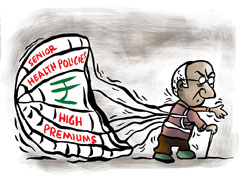
Iam 60 years and a loyal customer of Royal sundaram in medical insurance for 30 years. I was paying premium from 8k to now to 30 k with no claim. As a practical approach
I have a discipline of making 50% of premium nearest to thousands ina value fund considering that my claim will not be admitted, and this corpus fund will be utilised for the shortcoming.
Since there is no claim in the last 30 years it has now grown well.
As we know that medical insurance will have 18% GST and not getting anything after 30 years of premium paid despite no claim except the NCB in paper.
Considering my disciplined life style my anticipated medical expenses is 0 to 5 lacs in next 7 years which I can manage from medical corpus already available as 50% medical insurance paid.
Now, considering the life expectancy, living after 7 years is not possible, and so deciding now to suspend the medical claim and continue invest the 100% plus my own 50% totalling 150% of insurance in the value fund for my medical emergency by not depending on medical insurance company, doubting claim admitted or not or going for legal for rightful claim etc.
Moreover this corpus can also support my regual OPD or other medical expenses whereas mediclaim support only hospitalisation.
So, with increasing medical insurance premium, I am planning to suspend medical insurance and dropping 30 years of relationship with royal sundaram.
Please suggest and guide me, whether my decision to suspend medical insurance is correct? Or what best alternative should I do ?
Ans: You have shown great discipline and vision. Staying insured for 30 years with no claim is rare. Building a parallel medical corpus with 50% of premiums is also wise. Your thought process is practical, analytical, and responsible. I will analyse your plan from multiple angles and share clear guidance.
» Your disciplined approach till now
– You paid premiums regularly for three decades.
– You maintained loyalty with your insurer.
– You built a separate health fund alongside.
– This corpus now covers possible expenses for next 7 years.
– Your lifestyle control reduces medical risk.
– Such foresight is not common.
» Why many people continue insurance despite corpus
– Insurance is meant for unpredictable large events.
– Even a healthy person can face sudden high-cost illness.
– Sometimes medical bills cross Rs 15 to 20 lakh in a single year.
– These expenses can deplete a corpus in one stroke.
– Insurance gives financial shield against such shocks.
– It is like a seat belt – rarely used, but lifesaving when needed.
» Real cost of continuing medical insurance
– Premiums increase with age.
– GST adds 18% extra cost, which feels unfair.
– No-claim benefit looks good only on paper.
– You feel you are paying but not receiving.
– This frustration is genuine after 30 years.
– Yet insurance is not an investment.
– It is protection, like fire insurance for a house.
– Nobody wants fire, but protection is kept.
» Comparing insurance vs your self-funded plan
– Your 50% savings strategy created a good fund.
– By stopping insurance, you plan to invest 150% now.
– This fund can meet hospitalisation plus OPD needs.
– Insurance does not cover OPD, while your fund does.
– But insurance can pay for catastrophic expenses.
– Your fund may get exhausted if a rare but major illness comes.
– Recovery time for fund after big withdrawal may be slow.
– So balance is important rather than only one approach.
» Behaviour of medical costs in India
– Medical inflation is around 10-12% annually.
– Rs 5 lakh today may become Rs 10 lakh in 7 years.
– Hospitalisation cost for critical illness can cross Rs 20 lakh.
– Senior citizen cases are billed higher by hospitals.
– Cashless insurance helps avoid upfront cash burden.
– Without insurance, you may need liquidating investments at wrong time.
» Evaluating your current fund
– Corpus created from 50% savings is strong.
– It has given you confidence for next 7 years.
– You are comfortable that expected cost is within limit.
– However, actual medical cost is not predictable.
– Even if you expect low risk, medical events are random.
– Past 30 years claim-free does not guarantee next 7 years.
– Probability of claim rises after age 60.
– So assumption of zero or small cost may not always hold.
» Emotional factor in claims
– You mentioned doubt about claim approval.
– There are cases where companies delay or reject.
– But IRDA has tightened rules on senior citizens.
– If policy is active for more than 8 years, it is incontestable.
– Which means company cannot deny claim for non-disclosure.
– This protects loyal customers like you.
– So fear of rejection is lower today than before.
» Opportunity cost of premiums
– If you stop paying Rs 30,000 per year, you save cash flow.
– This saved amount can be invested in equity mutual funds.
– Over 7 years, this can grow and support corpus.
– Investment corpus has flexibility for OPD and medicines.
– Insurance premium, once paid, has no flexibility.
– This makes your argument valid from liquidity side.
» Taxation aspect of your corpus
– Equity mutual funds held for over 1 year attract LTCG.
– LTCG above Rs 1.25 lakh is taxed at 12.5%.
– Short-term gains are taxed at 20%.
– Debt funds are taxed as per your slab.
– Medical insurance premium however gives deduction under section 80D.
– This tax benefit will be lost if you stop insurance.
– But overall, your corpus is more flexible and useful for multiple needs.
» Behaviour of mutual fund corpus vs insurance
– Mutual fund corpus can grow with compounding.
– It can be withdrawn partially for OPD or hospitalisation.
– Insurance cannot be partially used. It only works during hospitalisation.
– Corpus remains with you or family even if not used.
– Insurance premium is lost if no claim happens.
– This makes corpus a more satisfying option.
» Your expected life span view
– You said you may not live beyond 7 years.
– This is only an assumption.
– Many healthy 60-year-old people live to 85 or 90.
– So planning with limited horizon may create gap.
– If you live longer, medical costs will keep rising.
– Your corpus must be designed for 20 years, not 7 years.
» Risk of stopping insurance completely
– If you stop now, restarting later will be costly.
– Premiums for senior citizens above 65 are very high.
– Pre-existing conditions will also be excluded for 3-4 years.
– So re-entry into insurance is difficult.
– Once stopped, door is almost closed permanently.
– Therefore, stopping completely is a high-risk decision.
» Balanced path forward
– Instead of full discontinuation, consider reducing sum insured.
– Take a smaller base cover to handle catastrophic illness.
– Use your medical corpus for OPD and small hospitalisation.
– This gives dual protection.
– You reduce annual premium burden but do not lose protection.
– You retain 80D tax benefit also.
– This approach balances peace of mind and flexibility.
» Alternative ideas for managing rising premium
– Opt for higher deductible plan to reduce premium.
– Shift to senior citizen specific plan with lower base.
– Keep top-up plan only, if available.
– These options lower annual outgo but retain protection.
– Your medical corpus can fill deductible portion.
– This way you use both insurance and self-fund together.
» Psychological comfort
– Insurance gives mental relief during crisis.
– Cashless admission removes stress for family members.
– Without insurance, they may run for funds at hospital.
– Your corpus is available, but encashment may take time.
– During critical illness, emotional burden is already high.
– Insurance at least takes away financial tension.
» Importance of asset allocation
– Your medical corpus must be invested carefully.
– Keep a part in safe liquid fund for emergencies.
– Keep another part in balanced equity mutual funds.
– Avoid direct equity, index funds, or ETFs.
– Index funds lack professional management in dynamic markets.
– Actively managed funds with experienced managers can beat index returns.
– This approach ensures better growth and safety.
– Use regular plan via Certified Financial Planner or MFD.
– They give guidance during market volatility.
– Direct funds look cheaper but miss ongoing advisory support.
» Final insights
– Your discipline and strategy is inspiring.
– Stopping insurance fully may expose you to big risk.
– Insurance is not investment but a protection tool.
– Use your medical corpus for regular and medium expenses.
– Keep a reduced insurance for catastrophic illness.
– This hybrid approach keeps costs under control.
– It also retains tax benefits and mental comfort.
– Fully depending only on corpus may be risky for long life.
– Consider that you may live 20 more years.
– Plan with safety cushion, not only for 7 years.
– Corpus with reduced insurance is a 360-degree solution.
– This balances flexibility, protection, growth and peace of mind.
Best Regards,
K. Ramalingam, MBA, CFP,
Chief Financial Planner,
www.holisticinvestment.in
https://www.youtube.com/@HolisticInvestment


 Question by Srinivas on Jul 29, 2022Hindi