


Need Expert Advice?Our Gurus Can Help

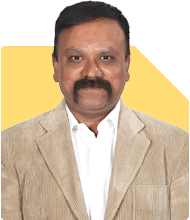
Nayagam P P |11305 Answers |Ask -Follow
Career Counsellor - Answered on Jun 24, 2025
Nayagam is a certified career counsellor and the founder of EduJob360.
He started his career as an HR professional and has over 10 years of experience in tutoring and mentoring students from Classes 8 to 12, helping them choose the right stream, course and college/university.
He also counsels students on how to prepare for entrance exams for getting admission into reputed universities /colleges for their graduate/postgraduate courses.
He has guided both fresh graduates and experienced professionals on how to write a resume, how to prepare for job interviews and how to negotiate their salary when joining a new job.
Nayagam has published an eBook, Professional Resume Writing Without Googling.
He has a postgraduate degree in human resources from Bhartiya Vidya Bhavan, Delhi, a postgraduate diploma in labour law from Madras University, a postgraduate diploma in school counselling from Symbiosis, Pune, and a certification in child psychology from Counsel India.
He has also completed his master’s degree in career counselling from ICCC-Mindler and Counsel, India.
... more
He started his career as an HR professional and has over 10 years of experience in tutoring and mentoring students from Classes 8 to 12, helping them choose the right stream, course and college/university.
He also counsels students on how to prepare for entrance exams for getting admission into reputed universities /colleges for their graduate/postgraduate courses.
He has guided both fresh graduates and experienced professionals on how to write a resume, how to prepare for job interviews and how to negotiate their salary when joining a new job.
Nayagam has published an eBook, Professional Resume Writing Without Googling.
He has a postgraduate degree in human resources from Bhartiya Vidya Bhavan, Delhi, a postgraduate diploma in labour law from Madras University, a postgraduate diploma in school counselling from Symbiosis, Pune, and a certification in child psychology from Counsel India.
He has also completed his master’s degree in career counselling from ICCC-Mindler and Counsel, India.
... more
Asked by Anonymous - Jun 24, 2025Hindi

Can someone provide NEST exam approximate Marks vs rank data of 2024 or expected marks vs rank data of 2025?
Ans: In NEST 2024, candidates’ total scores (sum of best three sections out of four, maximum 180) corresponded to specific all-India ranks, with the general category’s opening marks around 145–150 fetching ranks 1–30 and closing ranks near 1800 requiring about 80–85 marks. For NISER Bhubaneswar, the Round 1 closing rank was 1852 with roughly 82 marks, while CEBS Mumbai’s closing general-category rank of ~460 corresponded to about 70 marks. Category-wise, general candidates scoring 120–150 could expect ranks under 500, OBC candidates with 100–130 marks around ranks 600–1200, and SC/ST candidates with 80–110 marks near ranks 1500–2500. Section-wise cut-offs (SMAS) in 2024 ranged between 5–9 marks per subject for general and 3–7 for OBC. With NEST 2025’s exam difficulty likely similar, total qualifying marks (MAP) remain at 95th percentile for general and 90th for OBC; thus, a safe target is 130–140 marks for a top-500 rank and 90–100 marks for a sub-2000 rank among general candidates. OBC aspirants should aim for 110–120 marks to secure ranks under 1500. SC/ST candidates need 75–90 marks for ranks within 2500, and Jammu & Kashmir residents may enter NISER with as low as 30–40 marks owing to supernumerary seats. Rising registrations might edge cut-offs upward if paper difficulty eases; conversely, increased difficulty could lower required marks by 5–10 points.
The recommendation is to plan for at least 140 marks (general), 120 marks (OBC), and 90 marks (SC/ST) in NEST 2025 to secure desirable ranks for NISER and CEBS admissions, adjusting target scores according to mock-test difficulty and section-wise strengths. All the BEST for Your Prosperous Future!
Follow RediffGURUS to Know More on 'Careers | Money | Health | Relationships'.
The recommendation is to plan for at least 140 marks (general), 120 marks (OBC), and 90 marks (SC/ST) in NEST 2025 to secure desirable ranks for NISER and CEBS admissions, adjusting target scores according to mock-test difficulty and section-wise strengths. All the BEST for Your Prosperous Future!
Follow RediffGURUS to Know More on 'Careers | Money | Health | Relationships'.
CareerReply


You may like to see similar questions and answers below
Nayagam P P |11305 Answers |Ask -Follow
Career Counsellor - Answered on Jun 11, 2025

Dr Nagarajan J S K |2810 Answers |Ask -Follow
NEET, Medical, Pharmacy Careers - Answered on Jun 09, 2025
Asked by Anonymous - Jun 09, 2025

Radheshyam Zanwar |7085 Answers |Ask -Follow
MHT-CET, IIT-JEE, NEET-UG Expert - Answered on Jul 08, 2025


Latest Questions

Mayank Chandel |2709 Answers |Ask -Follow
IIT-JEE, NEET-UG, SAT, CLAT, CA, CS Exam Expert - Answered on May 04, 2026

Mayank Chandel |2709 Answers |Ask -Follow
IIT-JEE, NEET-UG, SAT, CLAT, CA, CS Exam Expert - Answered on May 04, 2026

Nayagam P P |11305 Answers |Ask -Follow
Career Counsellor - Answered on May 04, 2026

Nayagam P P |11305 Answers |Ask -Follow
Career Counsellor - Answered on May 04, 2026
Asked by Anonymous - May 04, 2026Hindi

Nayagam P P |11305 Answers |Ask -Follow
Career Counsellor - Answered on May 04, 2026



Ramalingam Kalirajan |11161 Answers |Ask -Follow
Mutual Funds, Financial Planning Expert - Answered on May 04, 2026


Nayagam P P |11305 Answers |Ask -Follow
Career Counsellor - Answered on May 04, 2026
Nayagam P P |11305 Answers |Ask -Follow
Career Counsellor - Answered on May 04, 2026
Nayagam P P |11305 Answers |Ask -Follow
Career Counsellor - Answered on May 04, 2026

Nayagam P P |11305 Answers |Ask -Follow
Career Counsellor - Answered on May 04, 2026
